The breasts of the Virgin Mary
Did Mary breastfeed the baby Jesus? She did, even though the Gospels don't say anything about it.
By Harald Strohm
The history of Christianity is interwoven with peculiar cults and narratives about breastfeeding. In one of his prophecies about the end times, Jesus is said to have declared: "Woe... to those who are nursing in those days!" (Gospel of Luke 21:23). On the way to the crucifixion, as Luke recounts, Jesus specifically turned to some women and cried out: "Daughters of Jerusalem, do not weep for me; weep rather for yourselves and your children! For behold, the days are coming when they will say: Blessed... are the breasts that have not nursed..." (23:29).
Strange—one would expect such a "Woe..." to have been directed at sinners and unbelievers. Why precisely at those "nursing" and their "children," to whom Jesus promised the Kingdom of Heaven? Breastfeeding here seems to be a building block of a psychology that can hardly be reconstructed by rational means. The concepts underlying it, however, have continued to operate in "deeper" layers of the soul and soon produced legends and cults that revolve around breastfeeding.
The most important point of connection was the Christmas story with the infant Jesus in the manger—which is likewise only recounted in Luke. While Luke does not explicitly mention breastfeeding, the imagination of believers soon added this, and with remarkable passion. From the early Middle Ages onward, depictions of the "Maria lactans," the nursing Mary, emerged with her characteristic night-blue cloak and dawn-red undergarment.
Among the gold-ground painters of the Middle Ages, the scene usually remained chaste and somewhat awkward; the exposed nursing breast of the Mother of God was depicted flatly and unnaturally. But by Lucas Cranach at the latest, it was then executed realistically and in aesthetic perfection. Many followed him—Rembrandt, José de Ribera, Andrea di Bartolo, Murillo, and Rubens.
This development was not easy for the official superiors of the Church, as images of women with exposed breasts now adorned the walls of houses of worship. This dangerously recalled the "loose women" who were denounced as sinners and a danger for all eternity. Fortunately, there were counter-images with which one could contrast the depictions of the nursing Mary in order to give propriety its due.
The Wound and the Breast
The Gospel of Matthew with the kings from the East and the childhood story in Luke had juxtaposed an image of his earliest childhood as a counterpoint to the Passion of Jesus. Just as with the Passion, vivid visions were also to be ignited by the childhood story. One need only think of the visions of the Christ child by Saint Francis, Saint Dominic, Saint Bridget, or Saint Anthony of Padua. All of these, especially those of Anthony, seized the hearts of the masses. With what tear-inducing empathy and artistic perfection was Anthony painted with the little Son of God in his arms—by van Dyck, for instance, by Tiepolo or Murillo.
But it did not remain merely with visions of the infant Jesus. Like Francis and other saints, ordinary believers also early stepped into the footsteps of following Christ. That is, they lived through the fate of Jesus himself once again. Inspired by the Passion, stigmata then opened on them like those of Jesus on the cross; but from the early childhood and nursing period of Jesus, they found themselves—touched and tempted by the breasts of the Mother of God.
In a—albeit late—epigram about Saint Augustine, it says that he, one knows not whether lamenting or reveling, said: "Here I graze from the wound (of Christ), here I am nursed from the breast (of Mary). Placed in the middle, I know not where to turn." The painters did not refrain here either from rendering the scene in lush vividness. First and foremost, and in the course of the Counter-Reformation, again Rubens.
In one of his monumental paintings, which can be seen in the Royal Academy of Fine Arts in Madrid, he shows Augustine with half-shy, half-gleaming eyes between the Risen One with his bleeding side wound and the youthful, enchantingly beautiful Mary, who frankly and without regard for prevailing moral standards offers the saint her right breast.
But even this was not yet enough: Several saints of the Middle Ages eventually found themselves no longer just standing perplexed "in the middle" between Mary and Christ like Augustine. They were clearly drawn to Mary's open blouse. The most famous was Saint Bernard of Clairvaux. A multitude of preserved paintings and simple, affordable prints for household use show him during his "Lactatio," his "milking." And whoever once marvels at such a colossal ceiling painting as that of Cosmas Damian Asam in the Baroque pilgrimage church in Fürstenfeld, Bavaria, can hardly help but suspect: However grotesque the late and secondary nursing of the saint may seem, it must have struck a nerve of the times.
Namely, the longing and quiet hope of its viewers, in the terrible times of plague, hunger, madness, and war, to receive comfort and holy strengthening from the breasts of the Mother of God. Across the mightily arched church ceiling, the Queen of Heaven and Ruler of the World there, with the six-month-old Christ child in her arms, sprays her milk stream into the mouth of the saint and founder of the order. The entire scene is overwhelmed by heavenly musicians and bathed in the pale pink light of the just-rising sun of a better world.
On this foundation, the strangest breastfeeding cult of Christianity ultimately grew. It was born among the "common people" and developed in the early modern period into a festival called "The Kingdom on Epiphany Day" or "The King Drinks." In wide parts of Europe, but especially up the Rhine Valley, with its center in the Netherlands, it inspired people across all social classes for several centuries.
The First Sip
The date of the festival was January 6, the day of the old Epiphany or Manifestation feast. On this day, since early Christian times, people had commemorated the manifestations through which the divinity of Christ had revealed itself. The birth by the Virgin was among them, but was later moved forward to the day of the winter solstice. Furthermore, the appearance of the Magi (Three Wise Men) as a sign of Jesus's divinity was celebrated early on January 6, as today the baptism at the Jordan as well as Jesus's first miracle at the wedding at Cana are still celebrated.
At the popular "The King Drinks" festival as well, the divinity of Jesus was celebrated, but in a completely different way: Here it was celebrated with a hearty sip of wine. Cultically elevated and symbolically charged, the whole thing became a sacred "Imitatio," an imitation of that first sip of milk that Christ had once drunk from Mary's breast.
A cake also played an important role in the festival, just as in today's Epiphany festival. A bean had been baked into the cake, and after the small festive gathering had assembled, everyone received a piece of it. Most came away empty-handed. But whoever found the bean was the Bean King and was crowned with a crown of tin or cardboard. He now had to treat the guests, similar to how Jesus did at the wedding at Cana.
He was king, on the one hand, because he had sought and found something, as the Three Kings once did with the Christ child. On the other hand, he had also been found by the bean. And thus he simultaneously assumed the role of the little Jesus and newborn King of the Jews. Representing him, the Bean King raised a glass of wine to open the domestic feast and took a first sip, while the festive gathering cheered and called out to him: "The King drinks." What he drank was the milk of the Mother of God "transubstantiated" into wine, into white wine.
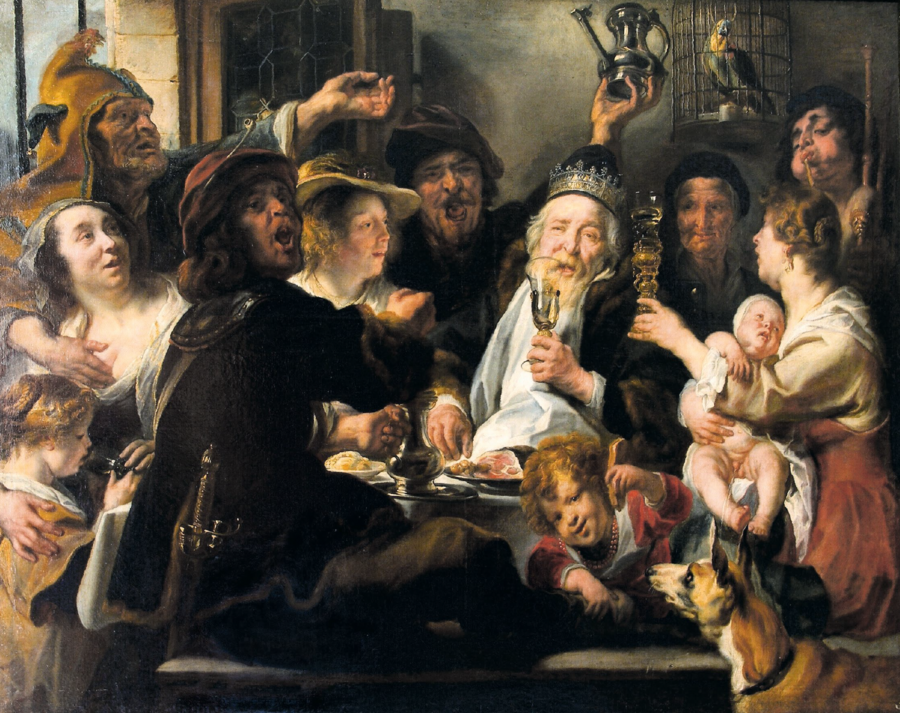
This "most holy" scene of the Bean King festival was captured in hundreds of ever-similar images, especially by Jacob Jordaens (1593–1678). A painting from the Hermitage collection shows the crowned Bean King as he raises his glass of alcoholic Mary's milk in his illustrious company. The naked, urinating, and probably actually freshly nursed infant on the right marks the reenacting role of the Bean King just as much as the fool does.
A Threefold "Cheers"
For like the Bean King, the fool also regresses into the world of early childhood nursing—by reaching quite uninhibitedly into the neckline of the lady before him. The entire arrangement thus shows a threefold "Cheers"—in honor of the newborn Son of God and the nursing breasts of Mary at Epiphany. At least this day had the makings of exuberant joy and sacred festivity.
The old custom lives on in remnants to this day. Or rather: It was revived, at least as far as the cake is concerned. Especially in Switzerland, it experienced a renaissance in the 1960s. At that time, the Bernese folklorist Max Währen became interested in the history of the baked good and discovered that the King's cake was dying out. He became enthusiastic about the idea of reviving the tradition.
So he joined forces with the bakers' and confectioners' association. The bakers created a recipe for a cake. On January 3, 1953, a radio broadcast went over the airwaves in which the story of the Bean King was told and attention was drawn to the cakes that were newly available for purchase in bakeries. With resounding success: 50,000 cakes with plastic figurines instead of beans are said to have been sold over the counters in the following days. When the major retailers jumped on the bandwagon, there was no stopping it.
Article appeared German in: Neue Zürcher Zeitung; January 4, 2020 / Literature and Art / Page 42