Almost like from One Thousand and One Nights
They came from far away to Bethlehem and brought gold, frankincense, and myrrh. Who were the strange three kings?
By Harald Strohm
"When Jesus was born in Bethlehem at the time of King Herod...," the Gospel of Matthew states: magoi apo anatolon, "Magicians from Anatolia,... prostrated themselves and brought him... gold, frankincense, and myrrh..." — Who were these "Magicians"?
Known in Rome as magi, in Greece as magoi, in Iran as moghu, in western India as maga, "Magician" was, until the Islamic conquests in the 7th century, a common collective term for the priesthoods in the sphere of influence of ancient Iran. The various traditions about them seem partly authentic, partly adventurous and prejudiced. What is illuminating for the narrative in Matthew is, first of all, that Magicians traveled through the ages to elections and investitures of the great kings; not least to prepare astronomical expertise there.
Behind this was the notion that all people were born under a particular star. But for the births and coronations of kings, outstanding celestial signs had to be established: real comets or unique constellations. Thus, when Mithridates Eupator (probably 132 BC) became King of Pontus, a comet star is said to have shone for a full seventy days, so bright that the sky seemed to glow.
Brother of the Sun
And when Ardashir Papakan took over the Persian Empire in 224 AD, the Chief of the Magicians confirmed: "The constellation Nahazikan (Capricornus) has set, and Ohrmazd (Jupiter) has returned to its culmination..., with Anahit (Venus) at its side..." Finally crowned, Ardashir could proclaim that he was "companion of the stars, brother of the Sun and the Moon..."
The legendary exaggeration of such reports is obvious. Of course, everyone knew that Ardashir, like so many other kings, was a "brother of the Sun" only in a metaphorical sense. Like scepter and crown, such attributions were symbols of royal power and their public celebration was ritualized declarations of loyalty.
The Magi story in Matthew also wants to be understood as "only" symbolic. If it were based on sober facts, the other New Testament authors would not have failed to tell of it as well. No, the Magi story was from the beginning meant to be a sacred story, a kind of overture to the Christian Good News, a praise of the Christ child and his royal dignity.
We do not know why it is inserted only in Matthew. But we can make an educated guess about what building blocks it was composed from and in what time frame. It must have been sometime in the years after 66 AD. For at that time an event occurred that provided talking points throughout the Roman Empire for years and which everyone who heard the Christian Magi legend must have been reminded of:
Nero's Staging
After long disputes about the role of Armenia, Emperor Nero initiated a clever maneuver that pacified the Parthian royal house and captivated the masses: a staging of world-political significance. Nero loved theatrical appearances and found his partner in the Armenian king. His name was Tiridates and, as Pliny attests, he was considered a Magician. Diplomatically arranged, this Tiridates now set out for Rome in the year 66: with an enormous procession that stretched over nine months and first led through Anatolia and Illyria, then across the Ionian Sea to Naples and from there to Rome.
It was considered the procession of the Magicians. As in a triumphal procession, Tiridates and his court rode ahead with all pomp, numerous Romans and a total of three thousand Parthian horsemen followed. Wherever they came, receptions were held in splendidly decorated cities. Nero let the festive Magi procession cost him a proud 800,000 sesterces day after day.
Arriving in Rome, Tiridates found the city decorated with lights and wreaths and the Forum arranged as an enormous theater. Citizens and nobles assembled wreathed with laurel and in white garments. The tiles on the surrounding roofs could no longer be seen due to those who had climbed up. Then Tiridates stepped up to Nero, threw himself down before him like the Magi before the Christ child and spoke, after his voice had first failed him: "Lord, I am a descendant of the Parthian dynasty founder Arsaces. I worship you as my God... and prostrate myself before you as before my Mithras."
This was diplomacy at its finest. For it meant: Armenia submits to Rome, but only as long as Rome adheres to the agreements sanctified by the treaty god Mithras. Nero then removed from Tiridates the tiara, Mithras's red pointed cap, and placed a diadem on him; with the words: "Hereby I make you King of Armenia, for I have the power to take and give kingdoms."
With full coffers, Tiridates then set off again. And indeed, exactly as we also read in Matthew: They "returned to their country by another route." In our Roman primary source it says: "The king did not return home by the way he had come, but from Brindisi."
The procession of Tiridates impressed itself so deeply into the cultural memory of Rome that it is recorded by three of its historians, namely Pliny, Suetonius, and Cassius Dio — and moreover in Matthew. In his work, however, the collective memory was recast into the literary form of a gospel and was meant to say as much as: Just as Tiridates came to Nero, so a procession of Magi also came to our Christian child in the manger, albeit only in a spiritual and figurative sense. For in its own way, the Christ child is also a ruler urbi et orbi.
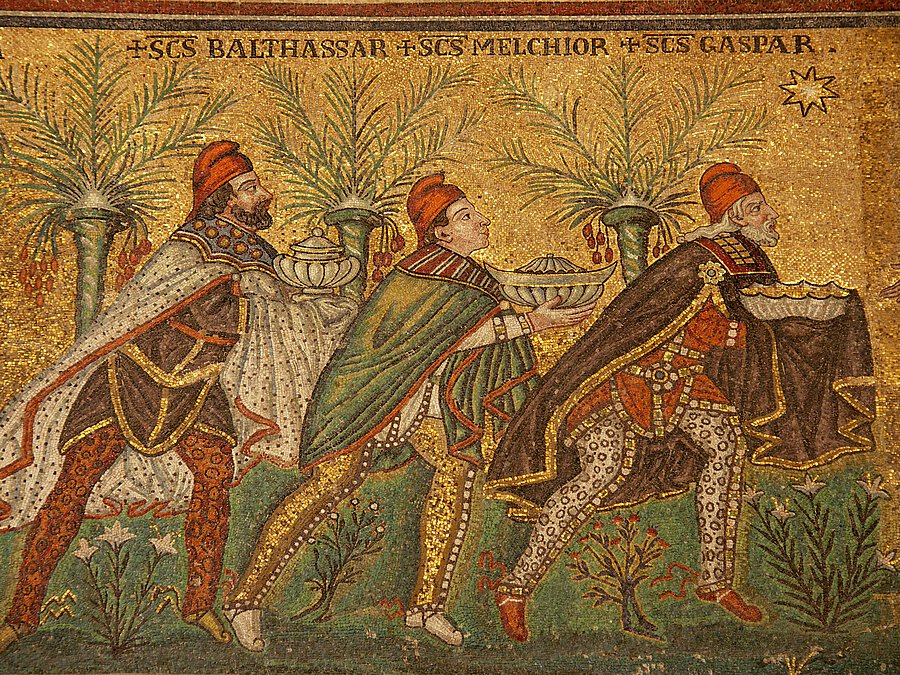
Pointed Shoes, Pointed Caps
But why did the unspecified number of Magi in Matthew eventually become three? And why did they become kings? The number three will simply have been derived from the three gifts that are mentioned. And these in turn seem to have had an Iranian prehistory. In any case, an Iranian-inspired royal inscription has been preserved from the buffer state of Commagene, in present-day eastern Turkey, which states: To celebrate my birth "the priests, wearing Persian garments, shall crown all with golden wreaths and offer abundant donations of incense and aromatic herbs."
It long seemed more difficult to understand why the Magi in early Christian sources were only considered kings from the third century onward. But perhaps written attestation is simply missing for the time before. For already the procession of Tiridates was considered a procession of the Magi and yet was simultaneously a royal procession. It is specifically stated that besides Tiridates and his children, those of Vologaeses, Pacorus, and Monobazus, all Arsacid high nobility, rode at the head of the procession.
Whether Tiridates and his group of princes and princesses also saw themselves as Magicians is, however, another question. It seems rather to have been a Roman labeling; perhaps from mocking irony: For in the West, "the Orientals" were already considered at that time a little too religious and susceptible to political encroachments by their priesthoods. However that may be: The equation of the Magi with kings is also reflected in the oldest depictions.
Thus the "Three Magi" on a mosaic in Sant'Apollinare Nuovo in Ravenna from the 5th/6th century wear exactly that characteristically Iranian royal costume that we also know from the royal Mithras in preserved paintings of the "Roman" Mithras cult imported from Iran: with their colorful brocade fabrics and bordered trousers, the pointed shoes and "Phrygian" pointed caps. Almost like something from the Arabian Nights.
In the Name of Sirius
And the Star of Bethlehem? Well, "Tiridates" means "he who is appointed by Tir," and Tir was the name of Sirius, the brightest star in the fixed-star sky. In this respect, the star of Tiridates always hovered over the long procession, and it must have actually been seen on many nights. But there is even more hidden behind the Star of Bethlehem. It is said to have preceded the "Three Kings" on their journey and finally stopped above the stable of the Christ child, according to Matthew. Astronomically, both are an absurdity: stars light-years away cannot be assigned to a concrete location and certainly cannot move toward it and then stop above it.
No, this is a childlike interpretation — as the great child psychologist Jean Piaget once had the course of the sun "explained" to him by some Geneva first-graders; in times when children could still trust their senses. He asked them: "Does the sun move?" Whereupon the little ones said: "Yes, when you walk, it follows us. When you turn, it also turns. Doesn't it follow you?" — "And if you walk backwards?" — "Then it turns around..."
And indeed: whoever strolls past the nocturnal treetops or "gnome caps" of a spruce plantation or a row of houses, over which the moon "stands," can observe exactly this: It does not "stand," but rather strolls along as if pulled by a balloon string. It seems to follow us and also to stop when we stop.
Regardless of whether this bit of child psychology was "consciously" (and probably again following an Iranian model) inscribed into our Three Kings legend: It brings us touchingly close to the world of the Christ child. And our carol singers, who carry their star as gilded fretwork before them, may therefore do more justice to the sacred nature of our "Three Kings" than modern astronomers who, in Kepler's tradition, have often invented astronomical events around the year zero as proof of biblical truth.
Article appeared German in: Neue Zürcher Zeitung; January 4, 2019 / Feuilleton / Page 34
https://www.nzz.ch/feuilleton/heilige-drei-koenige-sterndeuter-die-aus-iran-kamen-ld.1448361